A seller lists a home in O'Fallon, accepts an offer within the first week, and starts packing boxes. Then the buyer's inspection report comes back with a radon reading well above the EPA's screening level, and suddenly the closing timeline is on hold while both sides figure out who pays for a mitigation system. The seller is confused, because nobody ever told them they had to test for radon before selling. Technically, nobody did have to tell them. That's the part worth sitting with.
Missouri does not require home sellers to test for radon, and it does not require mitigation before a sale closes. The Missouri Department of Health and Senior Services says as much directly on its own site: there are no state laws that force testing or mitigation, full stop. Sellers only have to disclose an elevated reading if they already know about one, because they had it tested and kept the report. If they never tested, there's nothing to disclose. Missouri, along with most states, runs on a caveat emptor foundation for home sales: sellers report known material defects, and buyers bear the risk of what nobody looked for.
That gap between "not legally required" and "not going to come up" is where a surprising number of O'Fallon deals get renegotiated at the worst possible moment.
The Ground Underneath Isn't Uniform
O'Fallon sits on soil that geologists classify mostly as Mexico silt loam and Winfield silt loam, both heavy with clay that swells when it's wet and shrinks when it dries out. That cycle doesn't just crack driveways. It shifts foundations, opens pathways for radon to move through soil in ways that aren't consistent from one block to the next, and changes how basements handle groundwater depending on elevation. A radon zone map won't tell you much here, because two homes a few streets apart can produce very different test results depending on soil compaction, foundation age, and how the lot sits relative to nearby drainage.
That inconsistency is exactly why testing ahead of a listing tells you something a legal minimum never will.
One radon-tracking database that aggregates self-reported test results puts the average reading across O'Fallon's two ZIP codes, 63366 and 63368, at roughly 8.67 picocuries per liter. A separate, smaller sample of four submitted tests for the O'Fallon area shows an average closer to 7.8. Both are built on thin, self-reported samples, so treat them as directional rather than a certified number for any specific address. Both also sit well above the EPA's action threshold of 4.0 picocuries per liter.
A story that circulated in Missouri radon awareness discussions years ago described a newly built O'Fallon home that tested at 10 picocuries per liter, more than double the EPA's recommended action level, despite being brand new construction. New doesn't mean exempt. Neither does old. What actually predicts the finding is a combination of soil, elevation, and how the foundation was built, which means the honest answer to "will my home have a radon problem" is: test it and find out, because the geology here doesn't hand out a uniform answer.
Same City, Different Ground
Local inspection and foundation contractors who work across O'Fallon describe patterns that track closely with when and where a home was built, not just its age in years:
- Heritage of O'Fallon and Bryan's Cave, both built mostly in the 1980s, tend to show efflorescence and hairline foundation cracking tied to poured or block foundations sitting on that clay-heavy silt loam for three to four decades.
- WingHaven and Legends of O'Fallon, largely built in the 1990s and 2000s and sitting on higher ground, still deal with the same expansion and contraction cycle, which shows up as foundation settling cracks even in newer construction. Nearby areas closer to Dardenne Prairie show similar clay-driven soil movement, according to local foundation contractors.
- Woodlands of Cottleville and Peruque Creek, built closer to Missouri River floodplain soils, face a different problem: higher groundwater pressure and seasonal water table swings that can push moisture into basements during a wet spring, independent of the home's age.
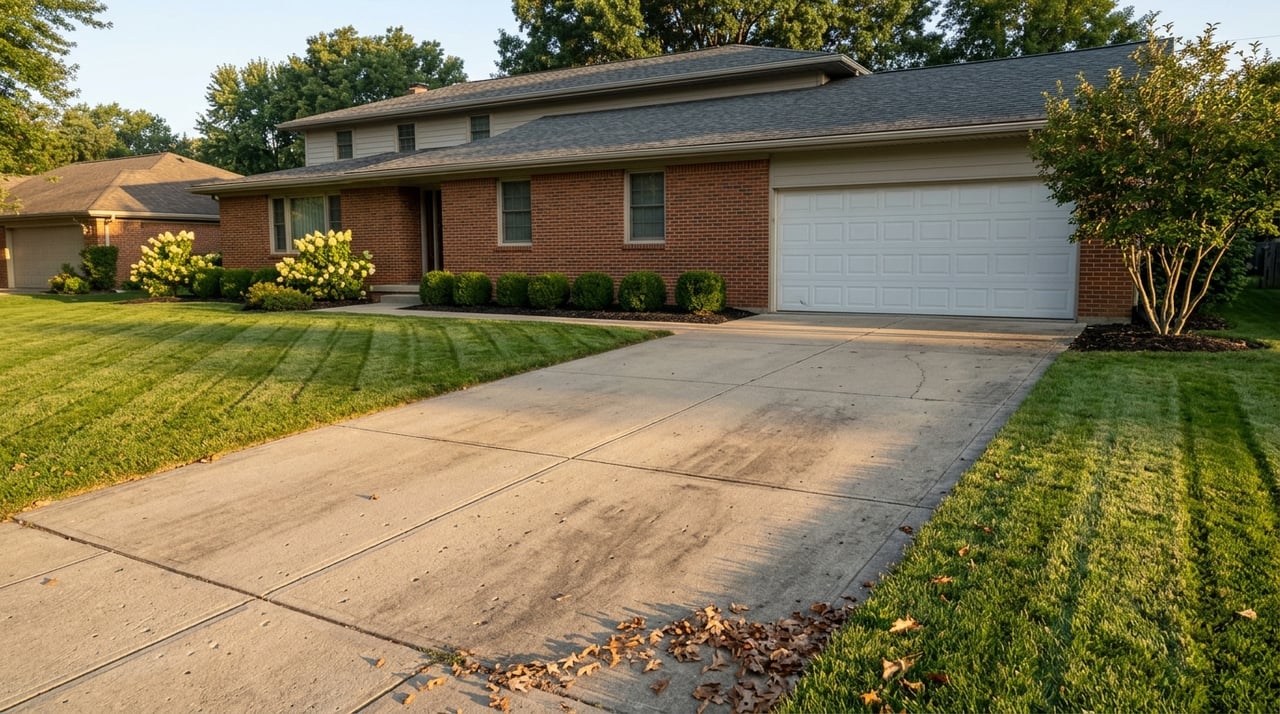
- Older concrete along the Bryan Road corridor, Belleau Creek, and Persimmon Woods, most of it poured in the 1980s and 90s, is reaching the age where driveways and patios start needing replacement, a visible, aboveground sign of the same soil movement that's also working on foundations out of view.
None of this means a given home has a problem. It means the type of problem a buyer's inspector is likely to flag correlates with where the home sits and when it went up, which is useful information before you're negotiating around it instead of planning for it.
Testing Early Changes the Negotiation, Not Just the Result
Here's the part that actually matters for a seller deciding what to do this fall. A radon test during a normal home inspection window typically runs $150 to $250. If it comes back high, a standard mitigation system for a home with a basement generally costs $1,000 to $1,500, with the broader market range running up to $2,000 depending on the foundation's complexity. Those are not large numbers relative to a home sale. What's expensive is finding them out for the first time during the buyer's inspection period, after the buyer has already picked paint colors and started measuring for furniture.
A seller who tests before listing has three options a seller who waits does not: fix it quietly on their own timeline, price the home to reflect a known condition and say so upfront, or confirm there's nothing to disclose and move forward with confidence. A seller who skips the test is simply hoping the buyer's inspector doesn't find something, which is not a strategy so much as a bet against fairly well-documented local geology.
Sewer line issues follow a similar logic. Local inspectors report finding root intrusion, cracks, and clogs in sewer lines across both older and newer O'Fallon neighborhoods, which is why a sewer scope, run separately from the standard inspection, has become a common add-on before a listing goes live rather than something buyers request after the fact.
What a Pre-Listing Sequence Actually Looks Like
For a seller who wants to walk into negotiations knowing rather than guessing, the order tends to matter as much as the individual steps:
- Schedule a 48-hour radon test during a period when the home can stay closed up normally, since short-term tests need stable conditions to produce a reliable reading.
- Have the foundation walked by someone who isn't also bidding on the repair, so the assessment isn't tangled up with an incentive to find work.
- Run a sewer scope, particularly on homes with mature trees near the line, since root intrusion is a slow problem until it isn't.
- Decide what to disclose and what to fix based on what actually turns up, not on what the law requires you to say.
None of this is about creating anxiety over a home that's probably fine. It's about not finding out the hard way, mid-contract, that this particular lot sits on the wrong side of the clay.
A Few Questions Sellers Ask
Am I required to test for radon before selling in O'Fallon? No. Missouri does not require sellers to test or to install mitigation. You are only required to disclose a test result you already have if it shows an elevated level.
If my test comes back above 4.0 picocuries per liter, does that kill the sale? Not typically. Mitigation systems bring most homes below the EPA's action level, and buyers generally treat a documented, addressed radon issue as a solved problem rather than a reason to walk.
How long does mitigation take once a system is scheduled? Scheduling the contractor and running a post-installation retest both take real calendar time, which is exactly why testing before you list beats discovering the issue mid-contract, when every extra day is a day the closing date slips.
Do all O'Fallon neighborhoods carry the same risk? No. The research is consistent that soil composition, elevation, and build era all shift the picture, which is the whole reason a blanket radon zone map isn't useful here and an actual test is.
If you're weighing a listing in O'Fallon this fall and want a straight read on what your home's inspection is likely to surface, the Lisa Adkins Team has spent more than two decades working through exactly these conversations with sellers across St. Charles County. Schedule your free consultation and we'll walk the property with you before a buyer's inspector ever does.